The Bright Path Fund
Aim of the Fund
The Bright Path Fund is supported by Homewards NI and the Community Foundation for Northern Ireland.
The Bright Path Fund is focused on utilising the Private Rented Sector (PRS) to unlock homes for young people leaving care, alongside the provision of tenancy and mental health & wellbeing support. The Fund will be delivered by the Community Foundation for Northern Ireland, in support of housing projects within The Royal Foundation’s Homewards programme.
In this phase, the fund will seek to support pilot projects across Northern Ireland which are sustainable, scalable, and inspirational for third parties to adopt.
The fund is focused on care-experienced young people aged 18-25 with low support needs.
The pilots are test and learn opportunities to strengthen evidence of effective interventions that can inform future strategic decision making and planning for this cohort. The pilots themselves will act as a diversionary housing pathway for this cohort who are either aging out of care or those whose return to family has broken down post leaving care.
The Referral Pathway is detailed further below, with the ambition that the New Foundations Accommodation Resource Panel will be utilised, once established. NIHE and the health trusts are key partners in the referral process.
The funding is available for providers to deliver both accommodation provision and support provision across pilot projects. The total funding available across the pilot is £220,000. For those interested in applying to this fund, we would like applicants to set out:
- Which region of Northern Ireland they would deliver a pilot project in.
- How many tenancies they believe are deliverable within the timeframe.
- The funding required to deliver their pilot.
Applicants answers to these points will form part of the assessment process.
For applications, we are seeking a lead provider, although consortium models are welcomed.
Person Journey
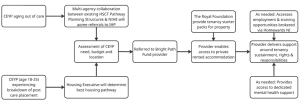
1. Referral Pathway
Young people will be referred through:
- Pathway planning structures within Health and Social Care Trusts, based on multi-agency discussions involving the Northern Ireland Housing Executive (NIHE), with evidence that the intervention will prevent homelessness.
- NIHE referrals where a young person’s post-care placement has broken down and they are at imminent risk of homelessness and meet eligibility criteria.
As the New Foundations Accommodation Resource Panel is still in development as part of New Foundations Programme, it is recommended that existing pathway planning processes within each Health and Social Care Trust continue to be used in preventing homelessness. However, to ensure that the IHP offer clearly demonstrates its role in preventing homelessness, partners from the Trusts and the Housing Executive will have a collaborative role in decision making to reflect the strong partnership developed between the Department of Health and the Housing Executive in relation to the New Foundations Programme. This approach ensures the right young people are supported to achieve the best possible outcomes while enabling multi-agency ownership of the process.
All referrals to the IHP must be coordinated through the Housing Executive Youth Homelessness Lead.
2. Accommodation Access
Applicants will use part of the fund to secure accommodation through the PRS. Funding may support:
- Accessing homes via third-party landlords.
- Rent in advance, deposits, guarantors, or bonds.
- Matching residents to appropriate homes.
- Ongoing landlord liaison.
- Rent subsidy (including use of Discretionary Housing Payments).
- Property maintenance (as agreed with landlords).
This project aims to demonstrate that change is possible, irrespective of location, as such applicants should demonstrate their breadth of geographical reach in being able to maximise PRS access for young people leaving care.
The objective is that properties secured must be affordable for the young person and support their ability to engage in education and/or sustain employment opportunities. Affordability and location should be considered together to maximise long-term stability and life chances for the young person.
The provider must demonstrate a robust matching process, clearly outlining how they will identify suitable candidates for placements, and how they will support young people to navigate the challenges associated with single or shared tenancies. This includes managing interpersonal dynamics, conflict resolution, and ensuring compatibility to maintain stable living arrangements.
Providers should also outline the intended timeframes of tenancies, with a clear preference for tenure models that avoid a “cliff edge”, ensuring that young people are not placed in accommodation with a fixed end point that could result in repeat homelessness. The approach should promote stability, continuity, and long-term independence wherever possible.
Applicants should outline their delivery model for securing homes and demonstrate scalability. This may include access cost models and rental guarantees. The selected provider must demonstrate value for money, anticipated reach, and alignment with the fund’s outcomes.
Where needed, the Royal Foundation will convene partners to help provide essential goods and furniture to help young people sustain their tenancies.
3. Support Provision
The provider will be expected to use part of the fund to deliver tenancy and mental health support for residents, and funding may be used to:
- Employ person-centred support leads.
- Provide tenancy skills and sustainment support, including access to independent specialist housing advice and comprehensive understanding of tenants’ rights and responsibilities through awareness sessions and training.
- Enable collaboration with Health and Social Care Trusts and targeted employment support services.
- Support residents to continue in or access education.
- Enable access to leisure activities.
- Operate drop-in/outreach facilities.
- Given the recent work by the Centre for Homelessness Impact on the benefits of cash transfers, we are particularly interested in their use within this pilot.
- Provide life skills development tailored to young people’s needs, including financial and budgeting skills, home management and basic DIY skills, nutrition awareness, and other essential independent living skills.
- The Royal Foundation will, subject to need, convene partners (locally and nationally) to develop a strategic partnership pathway of furniture and fittings to kit out properties.
The provider will work closely with Health Trusts and existing employment support programmes to deliver holistic, community-based support that enables care leavers to thrive and sustain their tenancies.
4. Eligibility Criteria
- Not be a Housing Association within the meaning of the Housing (Northern Ireland) Order 1976.
- Ability to ensure compliance with the Private Tenancies Act (Northern Ireland) 2022.
- Ability to provide accommodation that meets the Decent Homes Standard.
- Capacity to offer properties in areas with access to transport, education, health services, and employment.
- Registered charity, social enterprise, or voluntary/community organisation.
- Minimum 3 years’ experience delivering youth support, social care, or tenancy sustainment services.
- Appropriate safeguarding policies in place.
- Staff with qualifications in social work, youth work, or housing support.
- Ability to provide wraparound services, including life skills training, mental health support, employment and education guidance, mediation and crisis response.
In the interests of involving those with lived experience of leaving the care system, applicants will be expected to outline how they have and will involve young people in the design and delivery of their projects. Applicants are encouraged to explore opportunities to align their proposals with the Lived Experience Programme, to further embed the voices and insights of care-experienced young people in project delivery.
4.1 Who We Cannot Fund
Organisations or activities which promote causes that are contrary to our purposes. Causes and activities that are contrary to our purposes include, but may not be limited to, those outlined in our investment policy. We will not therefore fund organisations or activities which we determine are linked to the promotion of armaments, alcohol, human rights abuses, tobacco, or pornography.
In addition, we cannot fund:
- The advancement of religion. This includes organisations whose purposes include the advancement of religion;
- The establishment of endowment of any school or institution providing further education within the meaning of the Education and Libraries (Northern Ireland) Order 1972;
- The provision of assistance to any Housing Association within the meaning of the Housing (Northern Ireland) Order 1976;
- Promotion of religious or political activity, including any flags and emblems that may be deemed to be associated with such;
- CIC Companies Limited by Shares, or CICs without an asset lock clause. Eligible CICs must have at least three unrelated committee members, and/or the majority of the committee unrelated;
- Applications from individuals;
- Applications from statutory organisations;
- Vehicles;
- Retrospective funding;
- Substitution for statutory funding.
5. Application and Selection Process
Applications must be submitted online through the Community Foundation for Northern Ireland’s website www.communityfoundationni.org.
The application window to the fund will close at 12 noon on Tuesday 5th May 2026.
The Community Foundation will facilitate a panel of both experts working in, and people with lived experience of, housing and homelessness. Applicants will be asked to present to a panel following submission of a written application.
We anticipate the panel presentation will be held Wednesday 20th May 2026.
Grants should be spent by end June 2028 at the latest.
Please read the following text before beginning your application.
- You are a locally based not-for-profit, voluntary or community group working in Northern Ireland to improve the quality of life for local people
- You have an active management committee, with no two related cheque signatories
- You have a governing document, i.e. Constitution in the name of the applicant organisation
- You have a current bank account in the name of your organisation
- You have up to date annual accounts
- You have complied with the conditions of previous grants including submission of monitoring returns.
If you are unsure about any of the above text or have any other queries then please contact the Grants Team on 028 9024 5927 or via e-mail: applications@communityfoundationni.org.
Please note: The Community Foundation now uses a new Fundseeker Portal for all applications and monitoring. If this is your first time applying, or your first time accessing the portal, we recommend reading the ‘How to Apply’ guide before starting your application.
6. Monitoring and Reporting
Successful grantees will be expected to deliver and report on the following:
- Service throughput – Referrals received, progressed, supported.
- Housing Stability – % of young people sustaining tenancies for 12+ months.
- Wellbeing – Improvements in health and well-being.
- Independence – % of participants in work, training or education.
- Community Integration – % reporting positive social networks.
- Service Satisfaction – Feedback scores from service users.
- Safeguarding – Timely response and resolution of concerns/incidents.
7. Funding Overview
The fund (£220,000) is available to support both accommodation provision and support services. Subject to successful pilot outcomes, additional funding may be considered to enable scale.
Consortium models are welcomed, though a single lead provider must be identified in the application.
7.1 Funding Timeframe
- Delivery Period: We are aiming for projects to be delivered, with all activity completed, by 30th June 2028 but are open to conversations around delivery timeframes extending beyond this point.
- Spending Deadline: All funds must be spent within this timeframe.
- Review Points: Projects will be subject to interim and final review, with initial progress expected to be measurable within 12 months to inform future scaling and investment decisions.
8. Evidence and Evaluation
Applicants must outline their evidence base and evaluation structures as part of their proposal. This should include:
- A framework for measuring outcomes related to homelessness prevention, tenancy sustainment, education/employment progression, life skills development, and wellbeing.
- How data will be collected, analysed, and reported to support ongoing learning and continuous improvement.
- Commitment to involving young people in monitoring and evaluation processes.
Closing Date: May 5, 2026 12:00
May 5, 2026 12:00
Area:
Northern Ireland
Grant size:
One award of £220,000
Priorities:
• Care-experienced young people aged 18-25 • Private Rented Sector accommodation provision • Tenancy and mental health support

Ready to apply?


Grant FAQs
It is recommended that you read our Grant FAQs before starting your grant application.
GRANT FAQS
Who to speak to
Belfast Office
Community House
City Link Business Park
6a Albert Street
Belfast BT12 4HQ- Tel: +44 (0) 28 9024 5927
Derry Office
Building 83
Ledwidge Avenue
Ebrington
Derry~Londonderry, BT47 6GZ- Tel: +44 (0) 28 7137 1547
Quick Links





© COPYRIGHT 2026 | Charity Number: NIC105105 | Privacy Policy | Cookie Policy